Hands-On STEAM Learning at Avant Garde Brookside in Tulsa

Quick Answer
At Avant Garde Brookside in Tulsa, OK, teachers use Learning Beyond Paper, a play-based curriculum with hands-on STEAM activities (science, technology, engineering, arts, and math) for infants through Pre-K. Children learn by building, testing, mixing, and asking questions, with teachers planning activities that fit each age.
What STEAM Can Look Like on a Tuesday Morning
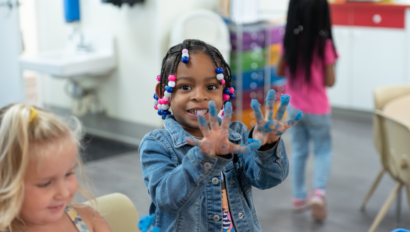
Picture a preschool classroom in Brookside on an ordinary morning. A few children might be at the water table, dropping a cork, a spoon, and a plastic boat in one at a time and guessing which will float. Two friends might be building a ramp from blocks and racing toy cars to see which one goes farthest. At the art table, someone might be mixing blue and yellow paint and calling out, “It turned green!”
Each of these is a small STEAM moment. Children are making predictions, testing ideas, and noticing what happens, all while they play.
What STEAM Means for Young Children
STEAM stands for science, technology, engineering, arts, and math. For young children, it looks a lot like curiosity in action:
- Science: noticing, wondering, and testing (“Will it sink?”)
- Technology: using simple tools such as magnifying glasses, scoops, and ramps
- Engineering: building, planning, and fixing (“How can we make the tower taller?”)
- Arts: painting, music, movement, and creating something new
- Math: counting, sorting, measuring, and comparing
NAEYC describes developmentally appropriate practice as teaching that builds on how children develop and on each child’s interests. Hands-on STEAM activities give children opportunities to learn in exactly that way.
The Curriculum Behind It: Learning Beyond Paper
Our teachers plan with Learning Beyond Paper, a curriculum with year-round lesson plans for infants, toddlers, preschool, and Pre-K that support literacy, STEAM, and social-emotional growth. Teachers use it to plan the week, and children experience it through real materials: blocks, paint, water, sand, books, and the world outside the classroom window.
Because lessons are designed for each age group, a STEAM activity for a toddler looks very different from one for a Pre-K child. Teachers watch what each child is curious about and adjust activities so every child has something to explore.
STEAM for Every Age
Infants (6 weeks to 1 year). STEAM begins with the senses. Babies might explore soft blocks with different textures, watch a ball roll across the floor, or listen to a teacher sing while they shake a rattle. These simple experiences help them learn about cause and effect. See our infant program.
Toddlers (ages 1 to 2). Toddlers love to fill, dump, stack, and knock down. A toddler might pour sand from one cup to another or match colored blocks to colored bins, practicing early sorting and measuring. See our toddler program.
Preschool (ages 3 to 4). Preschoolers start asking “why” and “what if.” They might plant seeds and check on them each day, count how many leaves they collected on a walk, or build a bridge that holds a toy car. See our preschool program.
Pre-K (ages 4 to 5). Pre-K children can take on bigger challenges, such as designing a boat from foil that holds pennies, then drawing and talking about what worked. These projects build early math, problem-solving, and teamwork that help prepare them for kindergarten. See our Pre-K program.
Why the Arts Belong in STEAM
The “A” in STEAM gives children another way to explore and share ideas. When a child paints what they saw on a nature walk or builds a sculpture from recycled materials, they’re observing, planning, and problem-solving, the same skills they use in science and math. Art also gives children who are still building language skills a way to show what they know.
Bringing STEAM Home in Tulsa
You don’t need special supplies to keep STEAM going at home. A few easy ideas:
- Kitchen science: Let your child help measure ingredients or guess what will happen when you mix them.
- Bath-time floating: Collect a few safe household items and test which ones float.
- Neighborhood walks: On a walk around Brookside or along Riverside, collect leaves and sort them by size, color, or shape.
- Ask a question back: When your child asks “why,” try asking, “What do you think?” and explore the answer together.
Ask your child’s teacher what the class is exploring this week, so you can talk about it at home.
Frequently Asked Questions
What curriculum does Avant Garde Brookside use?
Our teachers use Learning Beyond Paper, a play-based curriculum with hands-on STEAM activities planned for each age group from infants to Pre-K.
What does STEAM stand for?
STEAM stands for science, technology, engineering, arts, and math. For young children, STEAM learning happens through hands-on play, such as building, sorting, mixing colors, and testing ideas.
Is STEAM learning appropriate for infants and toddlers?
Yes. For infants and toddlers, STEAM looks like exploring textures, sounds, and simple cause and effect, such as rolling a ball or stacking blocks.
How will I know what my child is learning?
Families receive real-time updates and photos through the ProCare app, and teachers share progress at parent-teacher conferences in the fall and spring.
The best way to understand hands-on STEAM is to see it in a real classroom, where children are building, testing, and asking questions.
Schedule a tour of Avant Garde Brookside in Tulsa, OK and see STEAM learning in action.
Related Posts
All Posts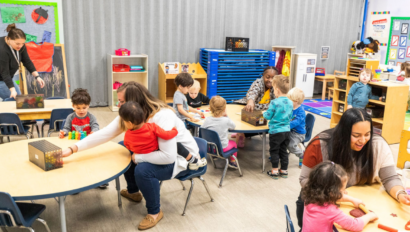
Beyond Free Play: The Skills and Milestones Behind Play-Based Curriculum in Tulsa, OK
The Hidden Structure Behind Play in Tulsa, OK: What Quality Looks Like in Practice